Conversion Formulas Handbook: Every Formula You Need
Every unit conversion is just multiplication — but knowing which number to multiply by is the hard part. This handbook collects the exact formulas for the most common conversions across nine measurement categories, explains why each formula works, and shows worked examples so you can apply them with confidence.
Whether you need a quick formula lookup for temperature, pressure, speed, or data storage, this reference covers all of them in one place. Use the category links to jump directly to what you need, or read straight through to build a mental map of how different measurement systems relate to each other.
Length Conversion Formulas
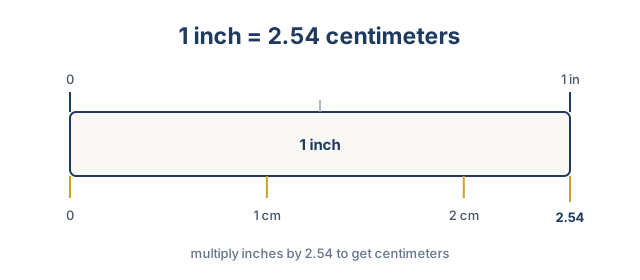
The metric system is based on the meter. The US customary system is anchored to the inch, which is defined as exactly 25.4 millimeters — an exact, legally defined relationship that makes all length conversions between systems perfectly precise. The core length formulas: feet to meters: m = ft × 0.3048. Meters to feet: ft = m ÷ 0.3048 (or × 3.28084). Inches to centimeters: cm = in × 2.54. Miles to kilometers: km = mi × 1.60934. Kilometers to miles: mi = km × 0.62137.
Quick mental shortcuts: to convert km to miles, multiply by 0.6 (within 3.5%); to convert feet to meters, multiply by 0.3. For inches to centimeters, multiply by 2.5 (within 1.6%). These are useful for estimation but use the exact factors for calculations requiring precision. Worked example: 100 feet = 100 × 0.3048 = 30.48 meters. A 400-meter athletic track = 400 ÷ 0.3048 = 1,312.3 feet = 437.4 yards.
Length Formulas at a Glance
ft → m:   m  = ft × 0.3048
m  → ft:  ft = m  × 3.28084
in → cm:  cm = in × 2.54
cm → in:  in = cm ÷ 2.54
mi → km:  km = mi × 1.60934
km → mi:  mi = km × 0.62137
yd → m:   m  = yd × 0.9144
nmi → km: km = nmi × 1.852
Weight and Mass Conversion Formulas
The kilogram is the SI base unit of mass. The pound is defined as exactly 0.45359237 kilograms — another exact legal definition. This means all weight conversions between metric and US customary are precise to any number of decimal places you need. Core formulas: pounds to kilograms: kg = lb × 0.453592. Kilograms to pounds: lb = kg × 2.20462. Ounces to grams: g = oz × 28.3495. Grams to ounces: oz = g ÷ 28.3495.
Worked example: 175 lb = 175 × 0.453592 = 79.38 kg. Converting back: 79.38 × 2.20462 = 175.0 lb — the round-trip confirms accuracy. For cooking: 1 ounce = 28.35 grams, so a 16 oz (1 lb) block of cheese = 453.6 grams. Quick check: multiply pounds by 0.45 for a fast kilogram estimate (within 0.6%).
Weight Formulas at a Glance
lb  → kg:  kg = lb  × 0.453592
kg  → lb:  lb = kg  × 2.20462
oz  → g:   g  = oz  × 28.3495
g   → oz:  oz = g   ÷ 28.3495
st  → kg:  kg = st  × 6.35029
kg  → st:  st = kg  ÷ 6.35029
t   → kg:  kg = t   × 1000  (metric tonne)
ton → kg:  kg = ton × 907.185 (US short ton)
Temperature Conversion Formulas
Temperature conversions are the one exception to simple multiplication — because the scales have different zero points, you need addition or subtraction too. Celsius to Fahrenheit: °F = (°C × 9/5) + 32. Fahrenheit to Celsius: °C = (°F − 32) × 5/9. Celsius to Kelvin: K = °C + 273.15. Fahrenheit to Kelvin: K = (°F + 459.67) × 5/9.
Worked examples: 100°C (boiling water) = (100 × 9/5) + 32 = 180 + 32 = 212°F. Body temperature 98.6°F = (98.6 − 32) × 5/9 = 66.6 × 5/9 = 37°C. Absolute zero = 0 K = −273.15°C = −459.67°F. Quick mental shortcut for weather: double the Celsius and add 30 gives a rough Fahrenheit estimate (e.g., 20°C → 40 + 30 = 70°F; actual: 68°F).
Area Conversion Formulas
Area scales as the square of linear dimensions. One meter = 3.28084 feet, but one square meter = 3.28084² = 10.7639 square feet. This squared relationship is the most common source of area conversion errors. Core formulas: square feet to square meters: m² = ft² × 0.092903. Square meters to square feet: ft² = m² × 10.7639. Acres to hectares: ha = ac × 0.404686. Hectares to acres: ac = ha × 2.47105.
Worked example: a 2,000 sq ft house = 2,000 × 0.092903 = 185.8 m². A 5-acre property = 5 × 0.404686 = 2.023 hectares. One football field (including end zones) = about 1.32 acres = 0.535 hectares = 5,350 m². Land in the US is sold in acres; land in most other countries is sold in hectares — this conversion matters for international real estate.
Volume Conversion Formulas
Volume mixes two incompatible systems: metric (liters, milliliters) and US customary (gallons, quarts, pints, cups, fluid ounces). Key relationships: 1 US gallon = 3.78541 liters. 1 liter = 0.264172 gallons. 1 cup = 236.588 mL. 1 fluid ounce = 29.5735 mL. 1 tablespoon = 14.7868 mL (= 3 teaspoons). 1 teaspoon = 4.92892 mL.
Worked example: a 2-liter soda bottle = 2 × 0.264172 = 0.528 gallons = 2.11 quarts = 8.45 cups. A US recipe calls for 3 cups of flour: 3 × 236.588 = 710 mL. Note: UK cup = 250 mL and Australian cup = 250 mL; US cup = 236.6 mL — check your recipe's country of origin when precision matters.
Pressure, Speed, and Data Storage Formulas
Pressure: PSI to kPa: kPa = PSI × 6.89476. Bar to PSI: PSI = bar × 14.5038. Standard atmosphere (1 atm) = 101.325 kPa = 14.696 PSI = 1.01325 bar. Speed: mph to km/h: km/h = mph × 1.60934. Knots to km/h: km/h = kn × 1.852. Meters per second to mph: mph = m/s × 2.23694.
Data storage uses two parallel systems — SI decimal (1 KB = 1,000 bytes) and binary (1 KiB = 1,024 bytes). For storage: MB to GB: GB = MB ÷ 1,000. GB to TB: TB = GB ÷ 1,000. For binary equivalents: MiB to MB: MB = MiB × 1.048576. GiB to GB: GB = GiB × 1.073741824. Time: minutes to seconds: s = min × 60. Hours to seconds: s = hr × 3,600. Days to seconds: s = days × 86,400.
Frequently Asked Questions
Why do temperature formulas use addition instead of just multiplication?
Because Celsius and Fahrenheit have different zero points. The freezing point of water is 0°C but 32°F — that 32-degree offset means you must shift the scale before multiplying. Kelvin has the same degree size as Celsius but starts at absolute zero, so you only need to add 273.15 with no scaling.
Why does area conversion not use the same factor as length?
Area is two-dimensional, so the conversion factor gets squared. 1 meter = 3.28084 feet, so 1 square meter = 3.28084² = 10.7639 square feet. The same squaring applies to volume (cubed): 1 cubic meter = 35.3147 cubic feet. Forgetting to square (or cube) the factor is the most common unit conversion error.
What is the most accurate way to convert between measurement systems?
Use the exact legal definitions wherever possible. Inch = 25.4 mm (exact). Pound = 0.45359237 kg (exact). These anchor the entire US customary system to metric with no rounding. Derived conversions like feet to meters (0.3048 = 12 × 0.0254) are also exact.
Where can I find a conversion calculator for these formulas?
Every formula in this handbook has a corresponding converter on this site. Use the tool links in the sidebar, or navigate to the relevant converter category from the main conversions page.
Related Tools
Related Converters
Related Guides
Conversion Formula Encyclopedia
18 min read
Complete Unit Conversion Handbook
25 min read
Measurement Systems Handbook: SI, Metric, Imperial, and US Customary
12 min read
📏 LengthMetric Prefixes Guide: Nano, Micro, Milli, Kilo, Mega, and Beyond
10 min read
Unit Conversion Dictionary: Common Units Defined and Cross-Referenced
15 min read
Engineering Units Handbook: Pressure, Force, Energy, Power, and More
15 min read
Sources
All conversion results are provided for general informational purposes only. Read our full disclaimer.