Metric Prefixes Guide: Nano, Micro, Milli, Kilo, Mega, and Beyond
Metric prefixes are the shorthand that makes the metric system work. Instead of writing 0.000000001 meters or 1,000,000,000 bytes, you write 1 nanometer and 1 gigabyte. Each prefix represents a specific power of ten, so the entire system scales from the subatomic to the astronomical using the same small vocabulary.
Whether you are converting milliliters in a recipe, reading a data storage spec in terabytes, or understanding a medical measurement in micrograms, knowing what each prefix means — and how to move between them — is one of the most broadly useful skills in measurement. This guide covers all common prefixes, their symbols, their scale, and real-world examples of where each appears.
How Metric Prefixes Work
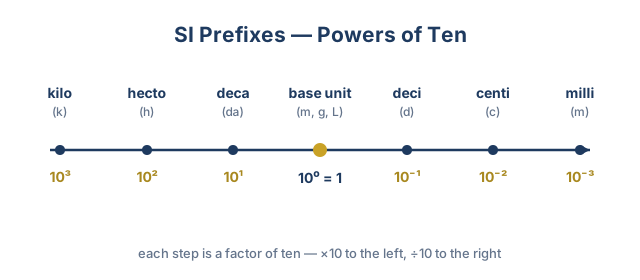
Every metric prefix multiplies the base unit by a specific power of ten. The base unit (meter, gram, liter, byte, watt, etc.) represents 10⁰ = 1. Prefixes larger than the base unit use positive exponents (kilo = 10³, mega = 10⁶); prefixes smaller than the base use negative exponents (milli = 10⁻³, micro = 10⁻⁶). To convert between prefix levels, you multiply or divide by powers of 10.
Because the relationship between any two adjacent prefixes is always a factor of 10, 100, or 1,000, conversion is arithmetic. For example, to go from millimeters to centimeters you divide by 10. To go from millimeters to meters you divide by 1,000. To go from kilograms to grams you multiply by 1,000. The prefixes do not change — only the base unit does.
Common Metric Prefixes at a Glance
Prefix   Symbol  Power     Value             Example
────────────────────────────────────────────────────────────
tera     T       10¹²      1,000,000,000,000 1 TB = 1 trillion bytes
giga     G       10⁹       1,000,000,000     1 GHz = 1 billion Hz
mega     M       10⁶       1,000,000         1 MHz = 1 million Hz
kilo     k       10³       1,000             1 km = 1,000 m
hecto    h       10²       100               1 hPa = 100 Pa
deka     da      10¹       10                1 daL = 10 L
─ base ─ ─       10⁰       1                 meter / gram / liter
deci     d       10⁻¹      0.1               1 dL = 0.1 L
centi    c       10⁻²      0.01              1 cm = 0.01 m
milli    m       10⁻³      0.001             1 mL = 0.001 L
micro    μ       10⁻⁶      0.000001          1 μg = one millionth of a gram
nano     n       10⁻⁹      0.000000001       1 nm = one billionth of a meter
pico     p       10⁻¹²     0.000000000001    1 pF = one trillionth of a farad
Small Prefixes: Nano, Micro, Milli, Centi, Deci
Nano (n, 10⁻⁹) appears in semiconductor manufacturing — modern processor transistors are measured in nanometers — and in nanotechnology and optics, where wavelengths of visible light run from 380 to 700 nm. Micro (μ, 10⁻⁶) is ubiquitous in medicine (micrograms in drug dosages, micrometers in cell biology) and electronics (microfarads in capacitors, microseconds in timing). The Greek letter mu (μ) is the official SI symbol; u is a common ASCII substitute.
Milli (m, 10⁻³) is the everyday small prefix — milliliters in cooking, millimeters in manufacturing tolerances, milligrams in vitamin labels. Centi (c, 10⁻²) appears almost exclusively in centimeters (body height outside the US, clothing dimensions, screen sizes). Deci (d, 10⁻¹) is rare in everyday English use, but deciliters appear in some European cooking recipes and medical lab results.
Large Prefixes: Kilo, Mega, Giga, Tera
Kilo (k, 10³) is the workhorse large prefix: kilograms, kilometers, kilowatts, kilobytes. Note that the SI symbol is lowercase k — uppercase K is not correct SI, though commonly seen for kilobytes in computing. Mega (M, 10⁶) covers megabytes, megapixels, megahertz, and megawatts. Giga (G, 10⁹) is standard for gigabytes, gigahertz, and gigawatts. Tera (T, 10¹²) now appears daily in storage specifications: terabyte hard drives and terabit data-center networks.
Above tera, peta (P, 10¹⁵) and exa (E, 10¹⁸) are used in data center and internet-traffic contexts. Global internet traffic is measured in exabytes per month. Below pico, femto (f, 10⁻¹⁵) and atto (a, 10⁻¹⁸) appear in physics and chemistry but rarely in everyday measurement.
Converting Between Prefix Levels
The key rule: moving one prefix step toward larger (e.g., milli to base, or base to kilo) means multiplying by the ratio between those two powers. Since the most common steps are separated by 10³ (milli → base → kilo → mega), the most common conversions multiply or divide by 1,000. Moving from milliliters to liters: divide by 1,000. Moving from kilograms to milligrams: multiply by 1,000,000 (10³ × 10³).
To avoid confusion: do not mix the prefix symbol case. The prefix k (kilo) is lowercase; the prefix M (mega) is uppercase; μ (micro) uses the Greek letter. In data storage, the binary prefixes kibibyte (KiB = 1,024 bytes), mebibyte (MiB = 1,024² bytes), and gibibyte (GiB = 1,024³ bytes) exist alongside the decimal SI prefixes — this distinction matters for accurate storage capacity reporting.
Quick Tips
- ✓
The mnemonic 'King Henry Died By Drinking Cold Milk' covers kilo, hecto, deka, base, deci, centi, milli from large to small.
- ✓
For data storage, always check whether a manufacturer uses decimal (1 GB = 10⁹ bytes) or binary (1 GiB = 2³⁰ bytes) — hard drives use decimal, RAM uses binary.
- ✓
When a drug label says '500 mg,' that is 0.5 g or 0.0005 kg. Always check the prefix when reading medical doses.
- ✓
Micro (μ) is 1,000 times smaller than milli (m). A microgram (μg) is one millionth of a gram, not one thousandth.
- ✓
Speed of light is approximately 300,000 km/s (3 × 10⁸ m/s) — 'mega' would be too small; 'giga' is the right scale: 0.3 Gm/s.
Frequently Asked Questions
What is the difference between milli and micro?
Milli (m) = 10⁻³ (one thousandth). Micro (μ) = 10⁻⁶ (one millionth). A milligram is 1,000 micrograms. When a prescription lists a dose in micrograms (μg), it is 1,000 times smaller than the same number in milligrams (mg) — a critical distinction in pharmacy.
Why is kilo abbreviated lowercase 'k' but mega is uppercase 'M'?
The SI system assigns case-specific symbols to each prefix to avoid ambiguity. k (lowercase) = kilo. M (uppercase) = mega. m (lowercase) = milli. Mixing cases is a common error — for example, 'MB' means megabyte, while 'mB' would theoretically mean millibyte (not a real unit), and 'Mb' means megabit.
What comes after tera?
Peta (P, 10¹⁵), then exa (E, 10¹⁸), zetta (Z, 10²¹), and yotta (Y, 10²⁴). These appear in scientific and large-scale computing contexts. A petabyte is 1,000 terabytes. Global data storage in data centers is often measured in exabytes.
Is centi only used for centimeters?
No, but centimeter (cm) is by far the most common centi use in everyday life. You will also encounter centiliters (cL) in some European recipes and centipoise (cP) as a viscosity unit in chemistry. The prefix itself means one hundredth (10⁻²) of any unit.
How do I convert from millimeters to kilometers?
From milli (10⁻³) to kilo (10³) is a span of 10⁶. Divide by 1,000,000. So 5,000,000 mm ÷ 1,000,000 = 5 km. Equivalently: 1 mm = 0.000001 km.
Try the Length Converter
📏 Open Length Converter →Related Tools
Related Converters
Related Guides
Hz, kHz, MHz, GHz, and RPM Explained
5 min read
Complete Unit Conversion Handbook
25 min read
Conversion Formula Encyclopedia
18 min read
Measurement Systems Handbook: SI, Metric, Imperial, and US Customary
12 min read
International Measurement Guide: Metric, Imperial, and US Customary
12 min read
Engineering Units Handbook: Pressure, Force, Energy, Power, and More
15 min read
Sources
All conversion results are provided for general informational purposes only. Read our full disclaimer.