Measurement Systems Handbook: SI, Metric, Imperial, and US Customary
Measurement systems are the agreed-upon frameworks that define how we quantify length, weight, volume, temperature, and other physical quantities. Four systems shape nearly all measurement encountered in daily life: the International System of Units (SI), the broader metric system from which SI derives, the imperial system historically used in Britain, and the US customary system used in the United States today.
Despite international adoption of SI, the legacy systems remain alive in everyday language, product labeling, and infrastructure in the US, UK, and other countries. Understanding where each system came from, which countries use it, and how the units relate to one another is essential for travel, recipe conversion, product specification, and scientific work.
The International System of Units (SI)
SI (Système International d'Unités) is the modern scientific standard maintained by the International Bureau of Weights and Measures (BIPM). Published in its current form in 1960, SI defines seven base units from which all other units are derived: the meter (length), kilogram (mass), second (time), ampere (electric current), kelvin (thermodynamic temperature), mole (amount of substance), and candela (luminous intensity).
SI is used universally in science and engineering, and it is the official measurement system of nearly every country on Earth. Even countries like the United States that use non-SI units in daily life use SI for all scientific, military, and pharmaceutical measurement. The defining feature of SI is coherence: derived units are formed from base units without additional conversion factors, and the metric prefix system makes scaling trivially systematic.
The Metric System
The metric system is the broader family of measurement systems that use decimal (base-10) relationships and standardized prefixes. SI is the modern, rigorously defined version of the metric system. Earlier metric systems — CGS (centimeter-gram-second) and MKS (meter-kilogram-second) — preceded SI and are still encountered in older scientific literature and some specialized fields.
The metric system originated in France in the 1790s as a rational alternative to the inconsistent systems then in use across Europe. By the late 20th century, metric was legally mandated in most nations. The EU standardized metric for trade and commerce. Australia, Canada, and most of Asia and Africa use metric as the primary everyday system. The metric system's base-10 scaling eliminates the awkward multiplication factors of imperial units (12 inches per foot, 3 feet per yard, etc.).
The Imperial System
The British imperial system was formalized in the Weights and Measures Act of 1824 and standardized measures used across the British Empire. Imperial units include the inch, foot, yard, mile, pound, ounce, stone, gallon, pint, and fluid ounce. Critically, several imperial units differ numerically from their US customary equivalents — most notably the gallon (1 UK gallon = 1.201 US gallons) and the fluid ounce.
The UK began metrication in the 1960s and is now officially metric for most legal and commercial purposes, but imperial units persist stubbornly in daily life. Road signs use miles and speed limits use mph. Body weight is commonly expressed in stone (14 pounds). Draft beer is sold in pints. Milk is sold in liters but many people still think in pints. This hybrid reality means UK residents often need to move fluently between both systems.
US Customary System
The US customary system evolved from British imperial measures that pre-date the 1824 Weights and Measures Act. The US broke from Britain before the imperial system was standardized, inheriting earlier English units that differ in some key ways. The US gallon (3.785 L) is smaller than the UK gallon (4.546 L). The US fluid ounce (29.574 mL) is slightly larger than the UK fluid ounce (28.413 mL).
The United States is one of only three countries (alongside Liberia and Myanmar) that has not officially adopted SI as its primary system for everyday use. However, the US officially defines its customary units in terms of SI: 1 inch = 25.4 mm exactly (since 1959), and 1 pound = 0.45359237 kg exactly. All US customary units are legally anchored to metric definitions. The US uses metric in science, medicine, nutrition labeling, and the military.
Key Cross-System Conversion Facts
━━━ LENGTH ━━━
  1 in = 25.4 mm (exact)    1 ft = 0.3048 m (exact)
  1 mi = 1.609344 km (exact)  1 yd = 0.9144 m (exact)

━━━ MASS / WEIGHT ━━━
  1 lb = 0.45359237 kg (exact)   1 oz = 28.3495 g
  1 st = 6.35029 kg = 14 lb      1 UK ton (long) = 1,016.05 kg
  1 US ton (short) = 907.185 kg

━━━ VOLUME ━━━
  1 US gal = 3.78541 L           1 UK gal = 4.54609 L
  1 US fl oz = 29.5735 mL        1 UK fl oz = 28.4131 mL
  1 US cup = 236.588 mL          1 UK cup ≈ 284 mL (not standardized)

━━━ TEMPERATURE ━━━
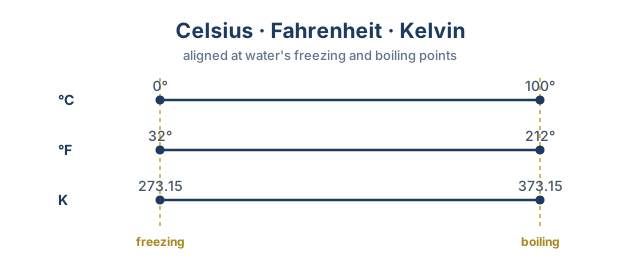
  °F = (°C × 9/5) + 32          °C = (°F − 32) × 5/9
  K = °C + 273.15               °R = °F + 459.67
Where Each System Is Used Today
SI/Metric: used in everyday life by ~95% of the world's population. Official legal standard in all EU countries, Australia, Canada, Japan, China, India, Brazil, and most of Africa and Asia. Also the standard for all international science, aviation weather, pharmaceutical doses, and food nutrition facts worldwide.
Imperial: road signs and speed limits in the UK. Body weight in stone in everyday UK speech. Draft beer pints in UK pubs. Shoe sizes across the UK. Imperial is rarely used in formal commerce or official documents, but remains culturally entrenched. US Customary: everyday measurement throughout the United States — construction, food packaging, body weight and height, road distances, fuel volume in gallons. US uses metric for wine and spirits (750 mL bottles), pharmaceutical drugs, nutrition labels, and scientific measurement.
Quick Tips
- ✓
Remember the US gallon vs. UK gallon difference before calculating fuel costs when traveling between countries — you could be off by 20%.
- ✓
US and UK fluid ounces are not the same — US fl oz ≈ 29.57 mL, UK fl oz ≈ 28.41 mL. A difference of about 4% per ounce compounds in bulk recipes.
- ✓
Speed limits: 60 mph ≈ 97 km/h. A quick approximation — multiply mph by 1.6 to get km/h.
- ✓
Body temperature reference: 98.6°F = 37°C (normal). 32°F = 0°C (freezing). 212°F = 100°C (boiling).
- ✓
1 stone (UK weight) = 14 pounds = 6.35 kg. Useful for UK health contexts.
Frequently Asked Questions
What is the difference between metric and SI?
SI is a specific, rigorously defined version of the metric system maintained by the BIPM. The metric system is the broader family of base-10 measurement systems. All SI is metric, but older metric systems (CGS, MKS) predate SI. In everyday use, 'metric' and 'SI' are interchangeable.
Why does the US still use customary units?
Historical inertia, infrastructure investment, and political resistance. The US officially attempted metrication in the 1970s but the effort was voluntary and largely failed. Replacing signage, tooling, consumer habits, and product labeling would cost hundreds of billions of dollars and requires coordinated cultural change.
Is the UK fully metric?
Legally, the UK is officially metric for trade and commerce. In practice, the UK uses a hybrid: metric for most food and commercial measures, miles for roads, pints for draft beer, and stone/pounds for body weight in everyday speech. Metrication is legally complete but culturally incomplete.
What are the seven SI base units?
Meter (length), kilogram (mass), second (time), ampere (electric current), kelvin (thermodynamic temperature), mole (amount of substance), candela (luminous intensity). All other SI units — newton, joule, pascal, watt, volt, etc. — are derived from combinations of these seven.
Why is the pound a unit of both weight and force?
In everyday US usage, 'pound' means pound-mass (lbm) — a measure of matter. In engineering, 'pound-force' (lbf) is the force that gravity exerts on one pound-mass at standard gravity. They are numerically equal at standard gravity, which causes the common conflation. In SI, the kilogram is mass and the newton is force — kept cleanly separate.
Related Tools
Related Converters
Related Guides
Complete Unit Conversion Handbook
25 min read
Conversion Formula Encyclopedia
18 min read
Conversion Formulas Handbook: Every Formula You Need
18 min read
Engineering Units Handbook: Pressure, Force, Energy, Power, and More
15 min read
International Measurement Guide: Metric, Imperial, and US Customary
12 min read
📏 LengthMetric Prefixes Guide: Nano, Micro, Milli, Kilo, Mega, and Beyond
10 min read
Sources
All conversion results are provided for general informational purposes only. Read our full disclaimer.