Engineering Units Handbook: Pressure, Force, Energy, Power, and More
Engineering calculations routinely cross between the SI (metric) and US customary or imperial systems. Pressure specs arrive in PSI from one supplier and kPa from another. Power ratings appear in horsepower on US equipment and kilowatts on European equivalents. Torque switches between foot-pounds and newton-meters depending on which wrench set you grabbed. This handbook gives you every major engineering unit family — definitions, formulas, and the SI/imperial relationship — so you can convert confidently without looking up the factor every time.
This reference is organized by physical quantity: pressure, force, energy, power, torque, density, temperature, and flow rate. For each, you will find the SI unit, the common imperial or US equivalent, the exact conversion factor, and notes on where each unit dominates in practice.
Pressure Units
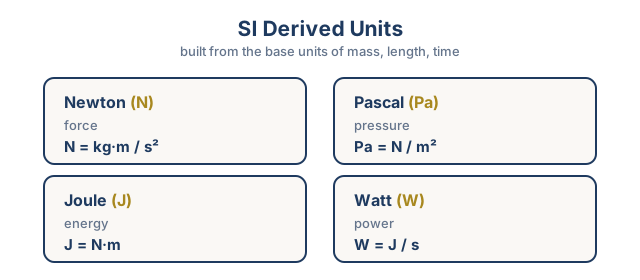
Pressure is force per unit area. The SI unit is the pascal (Pa = N/m²). Because one pascal is very small, engineering work uses kilopascals (kPa = 1,000 Pa), megapascals (MPa = 1,000,000 Pa), and bar (1 bar = 100,000 Pa). The US customary unit is PSI (pound-force per square inch). Key conversion: 1 PSI = 6.89476 kPa; 1 bar = 100 kPa = 14.5038 PSI; standard atmosphere (1 atm) = 101.325 kPa = 14.696 PSI.
In practice: tire pressure in the US is specified in PSI (30–35 PSI for passenger cars); in metric countries it is in kPa (210–241 kPa) or bar (2.1–2.4 bar). Hydraulic system ratings routinely reach thousands of PSI or hundreds of bar. Blood pressure uses mmHg (millimeters of mercury): 1 mmHg = 133.322 Pa. Industrial HVAC uses kilopascals or bar. Gauge pressure vs absolute pressure: gauge adds atmospheric pressure (~101.3 kPa / 14.7 PSI) to the gauge reading to get absolute.
Pressure Conversion Formulas
PSI → kPa:  kPa = PSI × 6.89476
kPa → PSI:  PSI = kPa ÷ 6.89476
bar → PSI:  PSI = bar × 14.5038
PSI → bar:  bar = PSI ÷ 14.5038
atm → kPa:  kPa = atm × 101.325
kPa → atm:  atm = kPa ÷ 101.325
mmHg → Pa:  Pa  = mmHg × 133.322
1 MPa = 145.038 PSI = 10 bar
Force Units
Force is mass times acceleration. The SI unit is the newton (N = kg·m/s²). One newton is the force needed to accelerate 1 kg at 1 m/s². In everyday terms: a 100 g apple resting on your palm exerts about 1 N of gravitational force. The US customary unit is the pound-force (lbf), sometimes written just 'lb' in a force context. Conversion: 1 lbf = 4.44822 N. Kilograms-force (kgf) appear in older European engineering: 1 kgf = 9.80665 N.
Kilopond (kp) is an older metric force unit equal to 1 kgf — seen in legacy German engineering documentation. Dyne (CGS system): 1 N = 100,000 dynes. Large-scale force (structural engineering) uses kilonewtons (kN) and meganewtons (MN). A 1,000 kg car at rest exerts about 9,807 N = 9.807 kN on the ground. Bridge load ratings in the US use kips (kilopound-force): 1 kip = 1,000 lbf = 4.448 kN.
Energy Units
Energy is the capacity to do work. The SI unit is the joule (J = N·m = kg·m²/s²). Practical energy units: kilojoule (kJ = 1,000 J), megajoule (MJ = 10⁶ J), kilowatt-hour (kWh = 3.6 MJ). The British Thermal Unit (BTU) is the heat needed to raise 1 pound of water by 1°F: 1 BTU = 1,055.06 J. One calorie (thermochemical) = 4.184 J; one food Calorie (kcal) = 4,184 J = 4.184 kJ.
Common conversions: 1 kWh = 3,412 BTU = 3.6 MJ. 1 BTU = 0.293 Wh. 1 therm = 100,000 BTU (used for natural gas billing). Electron-volt (eV) is used in particle physics: 1 eV = 1.602 × 10⁻¹⁹ J. For HVAC: cooling capacity is rated in BTU/hr or tons of refrigeration (1 ton = 12,000 BTU/hr = 3.517 kW). For food and nutrition, food Calories (kcal) are the standard; 1 kcal = 4.184 kJ.
Power Units
Power is energy per unit time. The SI unit is the watt (W = J/s). The US mechanical engineering unit is horsepower (hp): 1 mechanical hp = 745.7 W. Note that electrical hp = 746 W and metric hp (PS) = 735.5 W — these differ enough to matter in spec sheets. Common conversions: 1 kW = 1.341 hp. 1 hp = 0.7457 kW. Household electrical use is billed in kilowatt-hours (kWh).
For industrial motors, the transition from hp to kW happened decades ago outside the US. A 100 hp electric motor = 74.57 kW. Refrigeration tons: 1 refrigeration ton = 3.517 kW = 12,000 BTU/hr. Boiler horsepower (bhp) = 9.81 kW — rarely used outside legacy steam systems. In automotive contexts, brake horsepower (bhp) is the shaft output of the engine at the crankshaft, before drivetrain losses.
Torque, Density, and Flow Rate
Torque: the rotational equivalent of force. SI unit: newton-meter (N·m). US unit: pound-foot (lbf·ft), often written ft-lb. Conversion: 1 lbf·ft = 1.35582 N·m; 1 N·m = 0.73756 lbf·ft. Automotive torque specs: a car engine rated at 300 N·m = 221 lbf·ft. Fastener torque specs in metric: 10 N·m = 7.4 ft-lb. Density: SI unit kg/m³; common practical unit g/cm³ (= g/mL). Water = 1,000 kg/m³ = 1 g/cm³ at 4°C. 1 lb/ft³ = 16.0185 kg/m³.
Flow rate (volumetric): SI unit m³/s; practical units: liters per second (L/s), liters per minute (L/min), gallons per minute (GPM). 1 GPM = 3.785 L/min = 0.0631 L/s. Plumbing flow rates: residential supply lines typically deliver 0.5–1.5 GPM per fixture; industrial pumps are rated in GPM or cubic meters per hour (m³/hr). Mass flow rate: kg/s in SI; lb/min or lb/hr in US industry. 1 lb/min = 0.00756 kg/s.
Frequently Asked Questions
What is the difference between mass and force in engineering?
Mass (kg) is the amount of matter in an object — an intrinsic property that does not change with location. Force (N or lbf) is mass times gravitational acceleration. A 100 kg mass at Earth's surface exerts 981 N (100 × 9.81) of gravitational force. On the Moon (g ≈ 1.62 m/s²), the same mass exerts only 162 N. Engineers must be precise about whether they mean mass (kg) or weight/force (N or lbf).
Why does the US use horsepower instead of kilowatts for motors?
Horsepower was defined in the late 18th century by James Watt to market his steam engines against horse-drawn alternatives. US industry standardized on it before international adoption of SI. The rest of the world uses kilowatts for motors and kilowatt-hours for energy billing. Conversion is straightforward: 1 hp = 0.7457 kW.
What is the difference between PSI and bar?
Both are pressure units: 1 bar = 100,000 Pa (exactly), 1 PSI = 6,894.76 Pa. So 1 bar = 14.504 PSI. Bar is common in European industrial and scuba equipment (cylinder pressure, HVAC); PSI dominates US automotive, plumbing, and industrial use. They are close enough that 1 bar ≈ 14.5 PSI is easy to remember.
How do I convert BTU to kilowatt-hours?
1 kWh = 3,412 BTU, so BTU ÷ 3,412 = kWh. Equivalently: BTU × 0.000293 = kWh. For HVAC sizing, a 12,000 BTU/hr air conditioner = 3.517 kW. This is also called '1 ton of cooling' — a historical term from the heat absorbed by melting 1 short ton of ice per day.
Related Tools
Related Converters
Related Guides
Volts, Amps, Watts, and Ohms Explained
6 min read
🔩 PressurePressure Units Explained: PSI, kPa, Bar, atm, and mmHg
10 min read
Measurement Systems Handbook: SI, Metric, Imperial, and US Customary
12 min read
Conversion Formula Encyclopedia
18 min read
Conversion Formulas Handbook: Every Formula You Need
18 min read
Unit Conversion Dictionary: Common Units Defined and Cross-Referenced
15 min read
Sources
All conversion results are provided for general informational purposes only. Read our full disclaimer.