Pressure Units Explained: PSI, kPa, Bar, atm, and mmHg
Pressure is force distributed over area. Five units dominate practical measurement: PSI (pounds per square inch), kilopascal (kPa), bar, standard atmosphere (atm), and millimeters of mercury (mmHg). Each has a natural home — PSI in US industry and tires, kPa and bar in metric engineering, atm in atmospheric science, and mmHg in medical blood pressure — but equipment and specifications regularly cross those boundaries.
Understanding what each unit measures, where it comes from, and how to convert between units is essential for anyone working with pneumatics, HVAC, diving, meteorology, automotive, or healthcare equipment. This guide covers each pressure unit in depth, with the conversion factors and common reference values you will reach for repeatedly.
Pascal and Kilopascal — The SI Foundation
The pascal (Pa) is the SI base unit of pressure, defined as one newton per square meter (N/m²). One pascal is very small — normal atmospheric pressure is about 101,325 Pa — so the kilopascal (kPa = 1,000 Pa) is the practical unit for most metric applications. Tire pressure in kPa typically runs 200–250 kPa for passenger cars. Medical blood pressure cuffs sometimes report in kPa alongside mmHg. Meteorologists report atmospheric pressure in hectopascals (hPa), which are numerically identical to millibars (1 hPa = 1 mbar).
Because kPa is an SI unit, it is the standard in scientific and engineering calculations worldwide. European and Australian vehicle manuals list tire pressure in kPa. Compressed gas regulators in metric countries display kPa or MPa (megapascal = 1,000 kPa). The advantage of kPa is that it scales cleanly: atmospheric pressure ≈ 101.3 kPa, and the math is straightforward.
PSI — Pounds per Square Inch
PSI (pounds per square inch) is the dominant pressure unit in the United States for consumer and industrial applications. Tire pressure gauges, air compressors, hydraulic systems, water pressure regulators, and natural gas lines are all commonly rated in PSI in North America. One PSI equals approximately 6.895 kPa, so converting between systems is a multiplication by that factor or its reciprocal.
Typical reference values: car tire pressure 30–35 PSI; bicycle tire 80–130 PSI (road) or 25–35 PSI (mountain); residential water pressure 40–80 PSI; industrial hydraulics 1,000–5,000 PSI; deep-sea diving pressures can reach tens of thousands of PSI at extreme depths. Despite global adoption of SI units, PSI remains deeply embedded in US infrastructure and consumer products.
Bar — The Metric Near-Atmosphere
Bar is a metric unit equal to exactly 100,000 Pa (100 kPa), which makes it close to — but not exactly — one standard atmosphere (1 atm = 101.325 kPa ≈ 1.01325 bar). The bar is widely used in European industry, HVAC, hydraulics, and weather reports. Tire pressure stickers on European vehicles commonly list bar alongside PSI. Scuba regulators and compressed gas cylinders in Europe are rated in bar.
The millibar (mbar = 0.001 bar = 100 Pa = 1 hPa) is the standard unit for atmospheric pressure in weather forecasting worldwide, including in the United States. Sea-level atmospheric pressure is approximately 1013.25 mbar. One bar converts to 14.5038 PSI. The relationship 1 bar ≈ 14.5 PSI is a useful mental anchor.
Standard Atmosphere (atm)
One standard atmosphere (1 atm) is defined as exactly 101,325 Pa (101.325 kPa or 1.01325 bar). It was historically defined as the mean atmospheric pressure at sea level, and it remains the reference point for many scientific tables: gas laws, solubility tables, diving decompression tables, and altitude calculations all reference standard conditions at 1 atm.
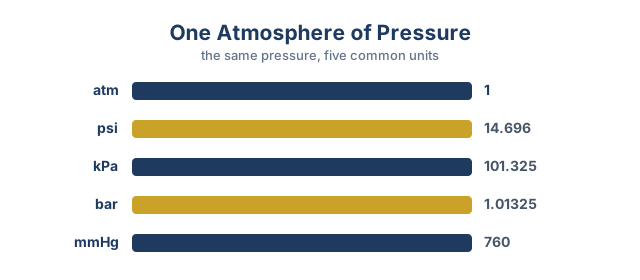
In practice, actual atmospheric pressure varies by altitude and weather. At sea level, normal pressure ranges from about 0.98 to 1.03 atm depending on weather systems. At the summit of Everest (8,849 m), atmospheric pressure is roughly 0.33 atm. Pressure altitude (used in aviation) is referenced to the standard atmosphere. The conversion: 1 atm = 14.696 PSI = 101.325 kPa = 1.01325 bar = 760 mmHg.
mmHg and Torr — Medical and Laboratory Pressure
Millimeters of mercury (mmHg) measures pressure as the height of a mercury column it can support. It originates from Torricelli's 1643 barometer experiment. The torr (symbol Torr) is nearly identical: 1 Torr = 1/760 atm ≈ 1.000014 mmHg — close enough that they are interchangeable in most practical contexts.
mmHg dominates in medicine. Blood pressure is universally reported in mmHg: a normal reading of 120/80 means 120 mmHg systolic, 80 mmHg diastolic. Intraocular pressure (glaucoma monitoring) is measured in mmHg. Gas partial pressures in physiology and diving medicine use mmHg or Torr. In chemistry labs, vacuum pressures and vapor pressures are often listed in Torr. One mmHg = 133.322 Pa = 0.133 kPa ≈ 0.0193 PSI.
Conversion Reference Table
         Pa          kPa        bar         PSI        atm        mmHg
1 Pa  =  1           0.001       0.00001     0.000145   9.87e-6    0.00750
1 kPa =  1,000       1           0.01        0.14504    0.00987    7.5006
1 bar =  100,000     100         1           14.5038    0.98692    750.06
1 PSI =  6,894.76    6.89476     0.068948    1          0.068046   51.715
1 atm =  101,325     101.325     1.01325     14.696     1          760
1 mmHg = 133.322     0.133322    0.001333    0.019337   0.001316   1

Quick-reference anchor points:
  Standard atmosphere: 1 atm = 101.325 kPa = 1.01325 bar = 14.696 PSI = 760 mmHg
  Car tire (typical): 32 PSI = 220.6 kPa = 2.206 bar = 2.18 atm
Quick Tips
- ✓
For tire pressure: multiply PSI × 6.895 to get kPa, or divide kPa by 6.895 for PSI. Mental shortcut: PSI × 7 ≈ kPa (within 1.5%).
- ✓
For European equipment with bar ratings: 1 bar ≈ 14.5 PSI. A 2 bar setting is about 29 PSI.
- ✓
Blood pressure (mmHg) to kPa: multiply mmHg by 0.133. 120 mmHg ≈ 16 kPa.
- ✓
Gauge pressure vs. absolute pressure: PSI can mean psia (absolute) or psig (gauge, relative to atmosphere). Gauge pressure = absolute − 1 atm. Most tire gauges read gauge pressure.
- ✓
Weather pressure in hPa (hectopascals) equals mbar numerically: 1013 hPa = 1013 mbar ≈ 1 atm.
Frequently Asked Questions
What is the difference between PSI and kPa?
PSI (pounds per square inch) and kPa (kilopascal) both measure pressure. 1 PSI = 6.89476 kPa. PSI is the US standard; kPa is the metric standard. For tire pressure, multiply your PSI value by 6.895 to get kPa.
Is bar the same as atm?
Close but not equal. 1 bar = 100 kPa = 100,000 Pa. 1 atm = 101.325 kPa. So 1 atm ≈ 1.01325 bar — about 1.3% larger. In many practical engineering contexts the difference is negligible, but it matters in precision scientific work.
Why is blood pressure measured in mmHg?
Blood pressure has been measured in mmHg since early sphygmomanometers used mercury manometers in the 1800s. The unit became so embedded in clinical practice and medical literature that it persists universally, even though mercury instruments are no longer used in most clinical settings.
What is gauge pressure vs. absolute pressure?
Absolute pressure is measured from a true zero (perfect vacuum). Gauge pressure is measured relative to ambient atmospheric pressure (~1 atm). A tire inflated to 32 PSI gauge contains air at 32 + 14.7 = 46.7 PSI absolute. Weather station pressure is always absolute.
What pressure unit is used in scuba diving?
Bar and PSI are both common in diving. European dive gear typically uses bar — a standard scuba tank holds 200–300 bar. US dive computers often display PSI — that same tank shows 2,900–4,350 PSI. Decompression tables use atm or bar for depth-pressure calculations.
Try the Pressure Converter
🔩 Open Pressure Converter →Related Tools
Related Converters
Related Guides
How to Read and Set Tire Pressure
6 min read
🔩 PressureHow to Convert PSI to kPa
5 min read
🔩 PressureWhat Is PSI? Pound-Force Per Square Inch Explained
5 min read
🔩 PressureWhat Is kPa? Kilopascal Explained
5 min read
🔩 PressureWhat Is Bar? The Bar Unit of Pressure Explained
5 min read
🔩 PressureAtmospheric Pressure Explained: What It Is and Why It Changes
6 min read
Sources
All conversion results are provided for general informational purposes only. Read our full disclaimer.